The Central & Southern Wānaka Structure Plan

Share The Central & Southern Wānaka Structure Plan on Facebook Share The Central & Southern Wānaka Structure Plan on Twitter Share The Central & Southern Wānaka Structure Plan on Linkedin Email The Central & Southern Wānaka Structure Plan link

Join the conversation about Wānaka’s future

Wānaka is growing and we want to make sure that growth protects the things that make our community a great place to live. Our goal is a thriving, well connected, liveable Wānaka where people, nature, and community thrive.

We’ve started work on a Central and Southern Wānaka Structure Plan – a long-term roadmap for how the area could grow and develop over the next three decades.

What is the Central and Southern Wānaka Structure Plan?
It’s a high-level blueprint that will help us plan for:

  • Future homes, local services and neighbourhoods.
  • Community facilities, parks and open spaces that support everyday life.
  • Infrastructure such as transport, water, needed to support growth.

As a 30-year roadmap, the plan will help us understand the area’s constraints, explore a range of options, and consider community needs. It will also guide future decisions to protect the environment, strengthen resilience, and uphold Wānaka’s unique character.

What it doesn’t do
The structure plan won’t change current zoning or automatically enable new development. Its role is simply to set a clear direction for how future planning, development decisions, and investment might unfold.

What areas are included in the scope?
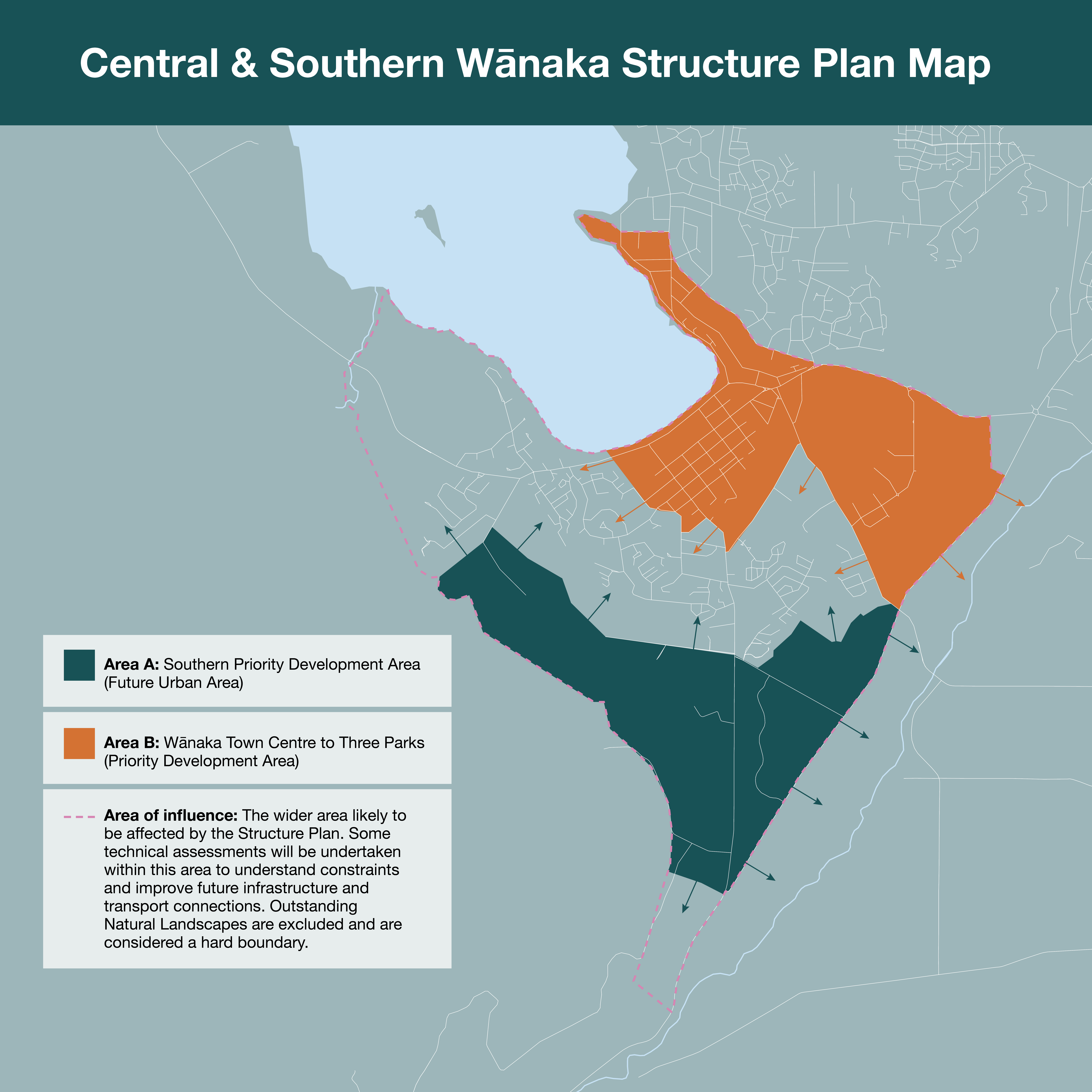
The Southern and Central Wānaka Structure Plan covers the parts of Wānaka where future growth and change are expected, and how these areas work together. This includes:

  • Southern Wānaka, as a future urban area for new neighbourhoods supported by well‑planned infrastructure.
  • Existing urban areas of South Wānaka, including places where more housing may be allowed for.
  • The Wānaka Town Centre–Three Parks Corridor, as the main mixed‑use, business, and employment area.
  • Wider areas of influence, where transport, infrastructure, open space, and environmental systems connect across the town.

Together, these areas make up the urban system that will shape Wānaka’s future growth.

Why are these areas being looked at together?
This project builds on the Queenstown Lakes Spatial Plan adopted in 2021. The plan sets the district’s long-term direction for growth and identifies two Priority Development Areas in the Wānaka area: Southern Wānaka, and the Wānaka Town Centre to the Three Parks Corridor.

While these areas have different roles, they are closely connected by how people live, travel, work, and access services. Planning them together through a single Structure Plan helps to:

  • Better understand how growth in one area affects the other.
  • Plan transport, infrastructure, and services in a more coordinated way.
  • Support a stronger, more connected Wānaka Town Centre.
  • Avoids fragmented or piecemeal development decisions.

Taking a combined approach doesn’t change the intent of the Spatial Plan - it simply helps deliver the outcomes more effectively by recognising that these areas function as one connected urban system.

What happens next?
Early technical studies commenced in mid-April 2026. We’ll be carrying out initial technical studies to understand what the key constraints and opportunities are in the area, including:

  • natural hazards
  • ecological and environmental values

This information helps us see where development is possible and where it isn’t, so any future growth scenarios are realistic and responsible, and we’ll be sharing updates as work progresses.

How can the community get involved?
There will be lots of opportunities to get involved and help inform and shape the development of the Central and Southern Wānaka Structure Plan as it evolves.

We value input from the community during this phase to help guide development of the different growth scenarios. We’ll keep you updated and share more details as the community engagement plans are finalised.

Stay informed
This page will be updated as the project progresses. You can also sign up for our updates to be kept informed of key milestones and opportunities to be involved.

More about the Spatial Plan
The Queenstown Lakes Spatial Plan was adopted in 2021. It sets the long-term direction for growth across the district. The Spatial Plan was developed through the Grow Well Whaiora Partnership between Central Government, Kāi Tahu, Queenstown Lakes District Council, and Otago Regional Council, and identified five Priority Development Areas where coordinated planning is needed to support housing, transport, infrastructure, and environmental outcomes, with coordinated planning taking the shape of a Structure Plan.

The priority development areas identified in the plan are:

  1. Town Centre to Frankton Corridor
  2. Five Mile Urban Corridor
  3. Te Pūtahi Ladies Mile
  4. Te Tāpuae Southern Corridor
  5. Southern Wānaka
  6. Wānaka Town Centre - Three Parks

Read the full Queenstown Lakes Spatial Plan


Join the conversation about Wānaka’s future

Wānaka is growing and we want to make sure that growth protects the things that make our community a great place to live. Our goal is a thriving, well connected, liveable Wānaka where people, nature, and community thrive.

We’ve started work on a Central and Southern Wānaka Structure Plan – a long-term roadmap for how the area could grow and develop over the next three decades.

What is the Central and Southern Wānaka Structure Plan?
It’s a high-level blueprint that will help us plan for:

  • Future homes, local services and neighbourhoods.
  • Community facilities, parks and open spaces that support everyday life.
  • Infrastructure such as transport, water, needed to support growth.

As a 30-year roadmap, the plan will help us understand the area’s constraints, explore a range of options, and consider community needs. It will also guide future decisions to protect the environment, strengthen resilience, and uphold Wānaka’s unique character.

What it doesn’t do
The structure plan won’t change current zoning or automatically enable new development. Its role is simply to set a clear direction for how future planning, development decisions, and investment might unfold.

What areas are included in the scope?
The Southern and Central Wānaka Structure Plan covers the parts of Wānaka where future growth and change are expected, and how these areas work together. This includes:

  • Southern Wānaka, as a future urban area for new neighbourhoods supported by well‑planned infrastructure.
  • Existing urban areas of South Wānaka, including places where more housing may be allowed for.
  • The Wānaka Town Centre–Three Parks Corridor, as the main mixed‑use, business, and employment area.
  • Wider areas of influence, where transport, infrastructure, open space, and environmental systems connect across the town.

Together, these areas make up the urban system that will shape Wānaka’s future growth.

Why are these areas being looked at together?
This project builds on the Queenstown Lakes Spatial Plan adopted in 2021. The plan sets the district’s long-term direction for growth and identifies two Priority Development Areas in the Wānaka area: Southern Wānaka, and the Wānaka Town Centre to the Three Parks Corridor.

While these areas have different roles, they are closely connected by how people live, travel, work, and access services. Planning them together through a single Structure Plan helps to:

  • Better understand how growth in one area affects the other.
  • Plan transport, infrastructure, and services in a more coordinated way.
  • Support a stronger, more connected Wānaka Town Centre.
  • Avoids fragmented or piecemeal development decisions.

Taking a combined approach doesn’t change the intent of the Spatial Plan - it simply helps deliver the outcomes more effectively by recognising that these areas function as one connected urban system.

What happens next?
Early technical studies commenced in mid-April 2026. We’ll be carrying out initial technical studies to understand what the key constraints and opportunities are in the area, including:

  • natural hazards
  • ecological and environmental values

This information helps us see where development is possible and where it isn’t, so any future growth scenarios are realistic and responsible, and we’ll be sharing updates as work progresses.

How can the community get involved?
There will be lots of opportunities to get involved and help inform and shape the development of the Central and Southern Wānaka Structure Plan as it evolves.

We value input from the community during this phase to help guide development of the different growth scenarios. We’ll keep you updated and share more details as the community engagement plans are finalised.

Stay informed
This page will be updated as the project progresses. You can also sign up for our updates to be kept informed of key milestones and opportunities to be involved.

More about the Spatial Plan
The Queenstown Lakes Spatial Plan was adopted in 2021. It sets the long-term direction for growth across the district. The Spatial Plan was developed through the Grow Well Whaiora Partnership between Central Government, Kāi Tahu, Queenstown Lakes District Council, and Otago Regional Council, and identified five Priority Development Areas where coordinated planning is needed to support housing, transport, infrastructure, and environmental outcomes, with coordinated planning taking the shape of a Structure Plan.

The priority development areas identified in the plan are:

  1. Town Centre to Frankton Corridor
  2. Five Mile Urban Corridor
  3. Te Pūtahi Ladies Mile
  4. Te Tāpuae Southern Corridor
  5. Southern Wānaka
  6. Wānaka Town Centre - Three Parks

Read the full Queenstown Lakes Spatial Plan


Got a question?

If you have a question, please submit it below and we'll answer it as soon as possible. All questions and answers will be published for everyone to see.

Email
loader image
Didn't receive confirmation?
Seems like you are already registered, please provide the password. Forgot your password? Create a new one now.
  • Share To help residents be informed, will your spatial plans include approximate forecasts on council rates percentage increases by year to pay for these expansions and infrastructure? Including this information will set expectations and help avoid future rates-increase-bill-shocks. on Facebook Share To help residents be informed, will your spatial plans include approximate forecasts on council rates percentage increases by year to pay for these expansions and infrastructure? Including this information will set expectations and help avoid future rates-increase-bill-shocks. on Twitter Share To help residents be informed, will your spatial plans include approximate forecasts on council rates percentage increases by year to pay for these expansions and infrastructure? Including this information will set expectations and help avoid future rates-increase-bill-shocks. on Linkedin Email To help residents be informed, will your spatial plans include approximate forecasts on council rates percentage increases by year to pay for these expansions and infrastructure? Including this information will set expectations and help avoid future rates-increase-bill-shocks. link

    To help residents be informed, will your spatial plans include approximate forecasts on council rates percentage increases by year to pay for these expansions and infrastructure? Including this information will set expectations and help avoid future rates-increase-bill-shocks.

    SuzanneM asked 18 days ago

    Hi Suzanne, thanks for your question.

    At the structure plan stage, it isn’t possible to reliably forecast Council rates increases on a year‑by‑year basis. Structure plans are deliberately high-level and focus on identifying where growth could occur over the long term. They do not include the detailed design, timing, funding, or delivery decisions that would be needed to accurately calculate infrastructure costs or future rates increases.

     Council does carry out early, high‑level testing of infrastructure needs and estimated costs as part of the structure planning process. This work helps ensure that any proposed growth locations are realistic and achievable before any further planning or design is progressed. While this is an important early check, it cannot provide the level of certainty needed to translate costs into specific rates impacts.

     We work on the principle that growth should pay for growth, with the aim of limiting impacts on existing ratepayers for new growth areas like Wanaka South. Future developers would be expected to pay all required development costs, including development contribution levies.

     Another thing to be aware of is that Wānaka South has been earmarked for growth for some time now through the Spatial Plan and has been factored into our long‑term planning, including Council’s 30-year infrastructure strategy. That means that planning for growth is not starting from scratch as some investment and preparatory work is already reflected in Council budgets and programmes.

  • Share Will this process consider essential long term infrastructure needed by healthy thriving communities? Eg. Tertiary Education opportunities…Environment Campus; Performing and Visual Arts facility; quantity, relevance and quality of indoor and external activities facilities. All needed to retain and-or attract young families/professionals/ creatives/ businesses start-ups etc and create the needed employment opportunities. on Facebook Share Will this process consider essential long term infrastructure needed by healthy thriving communities? Eg. Tertiary Education opportunities…Environment Campus; Performing and Visual Arts facility; quantity, relevance and quality of indoor and external activities facilities. All needed to retain and-or attract young families/professionals/ creatives/ businesses start-ups etc and create the needed employment opportunities. on Twitter Share Will this process consider essential long term infrastructure needed by healthy thriving communities? Eg. Tertiary Education opportunities…Environment Campus; Performing and Visual Arts facility; quantity, relevance and quality of indoor and external activities facilities. All needed to retain and-or attract young families/professionals/ creatives/ businesses start-ups etc and create the needed employment opportunities. on Linkedin Email Will this process consider essential long term infrastructure needed by healthy thriving communities? Eg. Tertiary Education opportunities…Environment Campus; Performing and Visual Arts facility; quantity, relevance and quality of indoor and external activities facilities. All needed to retain and-or attract young families/professionals/ creatives/ businesses start-ups etc and create the needed employment opportunities. link

    Will this process consider essential long term infrastructure needed by healthy thriving communities? Eg. Tertiary Education opportunities…Environment Campus; Performing and Visual Arts facility; quantity, relevance and quality of indoor and external activities facilities. All needed to retain and-or attract young families/professionals/ creatives/ businesses start-ups etc and create the needed employment opportunities.

    michaelsidey@hotmail;.com asked 28 days ago

    Hi Michael, that's a great question. Creating healthy, thriving communities is a key goal of the Structure Plan. This means thinking not just about roads, housing and jobs, but also about the places and services people need day to day – like schools, community facilities, cultural spaces, parks and recreation areas.

    The Structure Plan looks at what kinds of social infrastructure will be needed, how much is likely to be required, and when, to support future growth. This includes education, community and cultural facilities, recreation and open space. This work will involve ongoing discussions with organisations such as the Ministry of Education about schooling needs, as well as considering the broader range of cultural and recreational facilities that help attract and keep families, professionals, creatives and businesses in the area.

    That said, it’s important to understand that Structure Plans work at a big-picture level. They don’t usually name or commit to specific projects — for example, a particular tertiary campus or an arts facility. Instead, they focus on:

    • identifying future needs and gaps at a strategic level
    • plan for land, space and good access to support these facilities over time
    • helping social infrastructure connect with town centres and employment areas
    • provide signals to delivery partners such as central government, Council and the private sector

    Decisions about exact facilities, locations, design and delivery are usually made later, through detailed business cases, agency programmes, infrastructure strategies and partnership discussions.

    Taking this approach means the Structure Plan stays flexible and sets the right framework to support vibrant, inclusive communities and a wide range of job opportunities as the area grows.

  • Share How do you sign up for updates or to be kept informed of key milestones and opportunities as eluded to above? on Facebook Share How do you sign up for updates or to be kept informed of key milestones and opportunities as eluded to above? on Twitter Share How do you sign up for updates or to be kept informed of key milestones and opportunities as eluded to above? on Linkedin Email How do you sign up for updates or to be kept informed of key milestones and opportunities as eluded to above? link

    How do you sign up for updates or to be kept informed of key milestones and opportunities as eluded to above?

    MorganS asked 28 days ago

    Hi Morgan, you can subscribe to Let's Talk Kōrero Mai for updates as the Structure Plan progresses. Let’s Talk Queenstown Lakes District Council 

  • Share Hi, It's very hard to understand the area that is proposed to be affected by the Spatial Plan as the map in the QLDC newsletter (April/May), the map at the top right of this internet page and the map immediately above this text box are all slightly different. There are different areas coloured green or orange, while one map has additional arrows and dotted lines that could mean anything. Further the area encompassed by the dotted lines but not coloured green or orange needs to be more clearly described as the current words used (...."wider geographic area that may be directly affected by future growth"......) could mean anything the writer wants them to mean. Hence it is impossible for a submitter to understand the purpose of this particular "dotted area" in the Spatial Plan. In particular it would be helpful to understand what is proposed for the area bounded by Bills Way, Mt Aspiring Road, Ruby Island Rd and the lake front. Thank you on Facebook Share Hi, It's very hard to understand the area that is proposed to be affected by the Spatial Plan as the map in the QLDC newsletter (April/May), the map at the top right of this internet page and the map immediately above this text box are all slightly different. There are different areas coloured green or orange, while one map has additional arrows and dotted lines that could mean anything. Further the area encompassed by the dotted lines but not coloured green or orange needs to be more clearly described as the current words used (...."wider geographic area that may be directly affected by future growth"......) could mean anything the writer wants them to mean. Hence it is impossible for a submitter to understand the purpose of this particular "dotted area" in the Spatial Plan. In particular it would be helpful to understand what is proposed for the area bounded by Bills Way, Mt Aspiring Road, Ruby Island Rd and the lake front. Thank you on Twitter Share Hi, It's very hard to understand the area that is proposed to be affected by the Spatial Plan as the map in the QLDC newsletter (April/May), the map at the top right of this internet page and the map immediately above this text box are all slightly different. There are different areas coloured green or orange, while one map has additional arrows and dotted lines that could mean anything. Further the area encompassed by the dotted lines but not coloured green or orange needs to be more clearly described as the current words used (...."wider geographic area that may be directly affected by future growth"......) could mean anything the writer wants them to mean. Hence it is impossible for a submitter to understand the purpose of this particular "dotted area" in the Spatial Plan. In particular it would be helpful to understand what is proposed for the area bounded by Bills Way, Mt Aspiring Road, Ruby Island Rd and the lake front. Thank you on Linkedin Email Hi, It's very hard to understand the area that is proposed to be affected by the Spatial Plan as the map in the QLDC newsletter (April/May), the map at the top right of this internet page and the map immediately above this text box are all slightly different. There are different areas coloured green or orange, while one map has additional arrows and dotted lines that could mean anything. Further the area encompassed by the dotted lines but not coloured green or orange needs to be more clearly described as the current words used (...."wider geographic area that may be directly affected by future growth"......) could mean anything the writer wants them to mean. Hence it is impossible for a submitter to understand the purpose of this particular "dotted area" in the Spatial Plan. In particular it would be helpful to understand what is proposed for the area bounded by Bills Way, Mt Aspiring Road, Ruby Island Rd and the lake front. Thank you link

    Hi, It's very hard to understand the area that is proposed to be affected by the Spatial Plan as the map in the QLDC newsletter (April/May), the map at the top right of this internet page and the map immediately above this text box are all slightly different. There are different areas coloured green or orange, while one map has additional arrows and dotted lines that could mean anything. Further the area encompassed by the dotted lines but not coloured green or orange needs to be more clearly described as the current words used (...."wider geographic area that may be directly affected by future growth"......) could mean anything the writer wants them to mean. Hence it is impossible for a submitter to understand the purpose of this particular "dotted area" in the Spatial Plan. In particular it would be helpful to understand what is proposed for the area bounded by Bills Way, Mt Aspiring Road, Ruby Island Rd and the lake front. Thank you

    Hamish Gray asked 8 days ago

    Hi Hamish, thank you for getting in touch and we are sorry for any confusion. We have updated the map to clearly show the wider area likely to be affected by the Structure Plan. Some technical assessments will be undertaken within this area to understand constraints and improve future infrastructure and transport connections. Outstanding Natural Landscapes are excluded and are considered a hard boundary.

Page last updated: 05 May 2026, 06:00 AM