Long Term Plan 2027-2037
Councillors and staff are working together to build a Long Term Plan 2027-2037. This page includes lots of information about the context we’re working in, the steps we’ll take and how you can get involved.
What’s a Long Term Plan | What does Council do | Growth | Where does revenue go | How we’re building the plan | How you can get involved
What’s a Long Term Plan?
Every three years councils around the motu develop a Long Term Plan that sets the direction and budget over the next 10 years.
The Long-term Plan process supports the community and council to make decisions about where best to put council’s time and the community’s money. It details the projects Council intends to deliver and the services it will provide, and how it plans to pay for them.
A combination of reforms, growth and potential rate caps are putting more pressure than ever on Queenstown Lakes District Council budgets and capacity. This means difficult conversations need to be had when developing the next long-term budget.
This is why we want to know what matters most to you, so Council can prioritise the right things when making tough decisions about spending. Your feedback will be an important part of determining what to prioritise and discuss when making our 10-year budget.
But first, what does Council actually do?
we do a lot, but not everything.
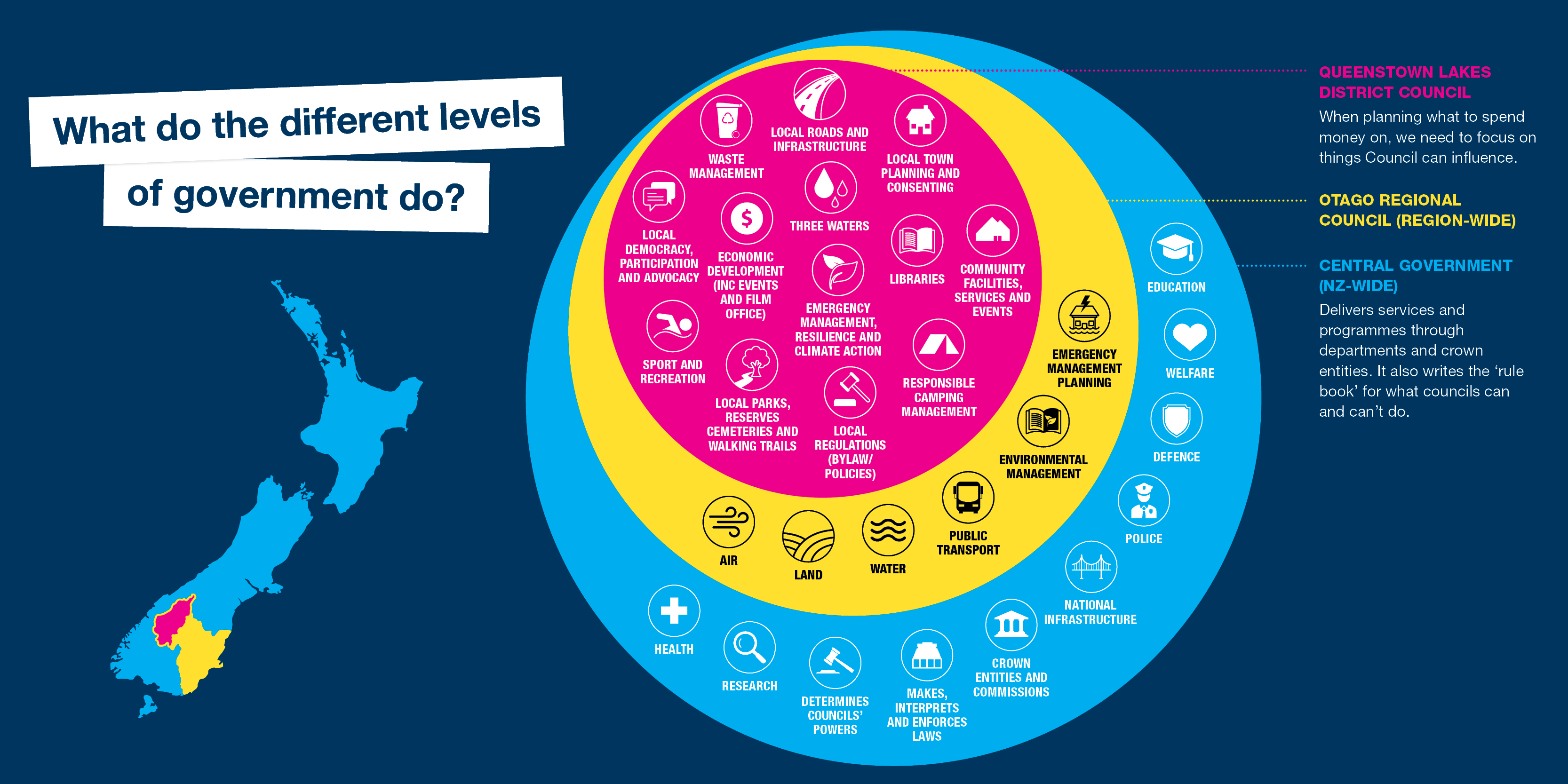
As shown in the diagram below, our role is to provide things like local infrastructure and services, and to make local regulations. Much of what we do is determined by Parliament in Wellington, or by Otago Regional Council in Dunedin.
Click here to enlarge the image.
While there are proposed changes to how Councils work. These changes are unlikely to come into effect soon. Therefore, we need to work within the areas of responsibility Council has right now, not what they may be responsible for in the future.
As you can see above, Council does a lot – especially when it comes to growth and essential services like roading, water and waste collection. Much of how Council operates behind the scenes may change in the next few years, such as reforming how town planning works, how councils work together and fund themselves, as well as how water management works.
While the essential work we do must go on, these reforms add more external pressure on Council during the budget planning period.
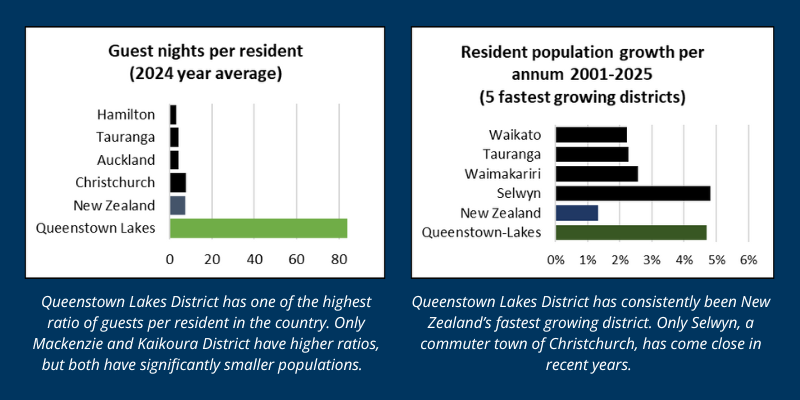
On top of all of Council's usual responsibilities, the Queenstown Lakes District happens to be Aotearoa New Zealand’s premier visitor destination and fastest growing district.
These two pressures have shaped Council's role and ability to service the district over the last 10 years. Responding to (and attempting to manage) growth and tourism has become a key part of what Council does.
A key part of managing the dual challenges of growth and catering to a high visitor population has been for the Council to ‘get the basics right first’ to ensure spending is allocated where it is needed most. This was the guiding approach for the last long-term budget.
So, where does Council revenue go?
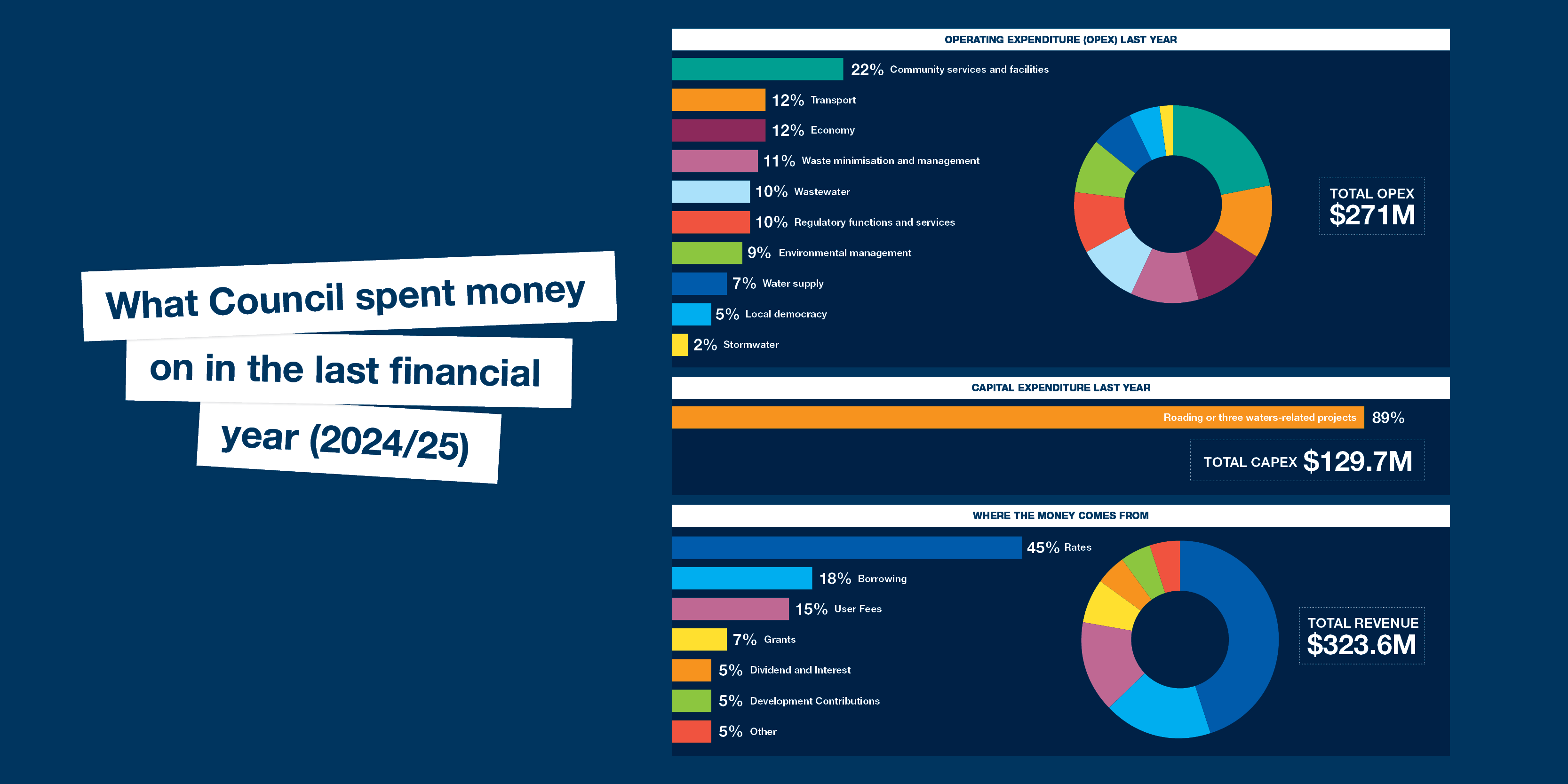
As shown below, most day-to-day Council money last year was spent on community services and facilities, three-waters (drinking, waste, and stormwater), roading and transport, and waste management. Most spending on big long-term projects, like infrastructure, was on roading and three-waters projects. Total Council spending is roughly split between these two categories, with most of the spending across both categories allocated to support the tremendous amount of growth and development in the district.
Click here to enlarge the image.
QLDC is in the process of creating a Water Services Council Controlled Organisation (WSCCO). The breakdown of spending in future budgets will change because of this.
QLDC’s ability to spend money on local issues is limited. Therefore, we need to carefully prioritise how ratepayers and the districts’ money is spent to get the most bang for our buck.
Within all the areas displayed above, hard decisions need to be made to determine if the services QLDC provides should be increased, maintained, or potentially decreased to adapt to a tough fiscal environment and potential rate capping.
The government in Wellington has proposed changes regarding caps on Council rates. While the details have yet to be determined, Council needs to incorporate potential capping of rates into its long-term planning. This means tough choices regarding what services Council should increase, maintain or decrease will need to occur during this budget period.
How we’re building the plan
Councillors and staff are working together through a series of workshops to build the draft Long Term Plan 2027-2037. At these workshops, Councillors work through all aspects of the plan, set strategic direction, confirm priorities and discuss levels of service for council activities.
The workshops are held in the Council Chambers, 10 Gorge Road, Queenstown. Most workshops will be open to the public in person. They’re also recorded and available to watch on our YouTube channel.
*Note dates and topics outlined below are subject to change at short notice.
30 June 2026 | 9.30am–12.30pm | Infrastructure Strategy: Growth scenarios, infrastructure challenges, climate resilience, asset management and investment priorities.
9 July 2026 | 12.00pm–4.00pm | Infrastructure Strategy: Waste management, social infrastructure and future investment priorities.
14 July 2026 | 11.30am–3.00pm | Infrastructure Strategy: Transport planning and investment.
16 July 2026 | 9.00am–4.00pm | Rates, Revenue & Financing / Service Planning: Funding approaches, activity plans, levels of service and performance measures.
18 August 2026 | 9.30am–4.00pm | Rates, Revenue & Financing: Funding options, visitor economy funding, growth funding.
19 August 2026 | 1.30pm–5.00pm | Capital Programme: Capital project priorities, investment options and financial implications.
3 September 2026 | 1.00pm–4.00pm | Expenditure: Financial assumptions, operating expenditure and affordability measures, capital project priorities.
17 September 2026 | 12.30pm–4.30pm | Revenue: Funding options, policies, development contributions.
29 September 2026 | 12:30pm-3:30pm | Capex and Opex: Updated services, budgets, operating expenditure, capital projects, financial modelling
13 October 2026 | 9.00am–3.00pm | Refinement: Refining funding options and policies, Significance and Engagement Policy
29 October | 1:00pm-4:00pm | Refinement: Refining capital project and operating expenditure planning, financial metrics
19 November 2026 | 10.00am–1.00pm | Final Review: Review of the draft Financial Strategy, Infrastructure Strategy, key policies and financial measures, potential consultation topics.
How to get involved
Community feedback helps inform Council's decisions and supports the development of a Long Term Plan that reflects local priorities, addresses future challenges, and delivers value for the district over the next decade.
Consultation will play an important role as we develop this plan. Here’s what you can expect:
- Pre-engagement – December 2025-February 2026 ✅ You'll find all the feedback in the document library.
- Community check in via Annual Plan 2026-2027 Consultation ✅ You'll find all the feedback in the document library.
- Formal consultation on a draft Long Term Plan – March 2027.
